Sunday, January 18, 2015

Revisiting the Clemson Family: #SaveTillman's Darker Side

One day, I'll actually post about science again (hopefully this term because I'm taking a seminar on getting more involved with science communication!) Instead, it's another round of "I love you, but I'm disappointed in you" to the Clemson community.

From last time:
Some of my best memories are at Clemson (if anyone at this point is questioning devotion, I graduated from there and by virtue of Tiger Band for four years attended all home games in my time), and my favorite part is the Clemson family- the idea that all Tigers, no matter your stripe, are bonded by this school. Taking a step back it sounds hokey, but in person my experiences were overwhelmingly positive. When I read posts like the above, I honestly question the welcomeness I felt. Is the Clemson family only a veneer, that only certain members can be considered 'family'? I'd like to think not. #ClemsonStrong shouldn't be about pounding chests for the faith or starting another Crusade, but rather embracing our diversity as what MAKES Clemson a strong institution. 
Weird, that the words still mostly apply about nine months later. Again, we see a majority feel persecuted, but this time it's a different minority, and one that cannot be closer to the Clemson family... because it IS a part of the Clemson family.

If you haven't paid much attention to what's going on around TigerTown, there's been a string of negative incidents over the last few months.

  • Following Darren Wilson's lack of conviction and the lack of indictment in Eric Garner's death (recap for both incidents here), protests against racial profiling and police brutality took place in cities and on campuses across the country, including Clemson. A small but passionate group of students led several protests, including  a "die-in" on Bowman Field. On the app YikYak where users anonymously post and others can up or downvote them, there was a small but vocal counter response: 
  • Shortly after the uproar over anonymous insensitivity, history repeated itself and a greek organization hosted a 'Cripmas' party. When the story first broke, quite a few commenters mentioned they didn't see it as offensive, putting it on the same level as mafia or wild west themed parties. While well-intentioned, such sentiments missed the point that having a 'gangsta' themed party soon after the Michael Brown decision (in which some media outlets and peanut galleries called the teenager a 'thug) was poorly timed, not to mention the trivialization of gang brutality. 
  • In response, See the Stripes organized a student protest on Library Bridge. President Clements was present and addressed student questions. He later sent out an email encouraging the Clemson family to come together and announcing several initiatives towards discussing diversity in 2015. 
  • 2015 is here! Members of Clemson's faculty, staff, and student body marched from Death Valley to Sikes, airing a list of grievances of when the university "failure to fulfill and uphold Mr. Clemson's vision and its own mission, particularly to "educate undergraduate and graduate students to think deeply about and engage in the social, scientific, economic and professional challenges of our time" among other things. 
  • Clemson's Faculty Senate votes to rename Tillman Hall, but tables the motion. The facutly senate can't actually change the name, but can make a recommendation to the Board of Trustees, which can then bring it up in the state legislature. 

Now we're caught up. And Tiger Nation? I love you, but man do we need empathy everywhere. 

While there are those that agree with the proposal, I've seen mostly a backlash (and maybe that's my feeds, but it feels large... like a majority maybe...). It falls into a few categories, illustrated here by various facebook, twitter, and change.org comments, mostly that the name is traditional/iconic for Clemson. Curiously, despite Tillman being a seminal figure in the creation of Clemson University, the building we now know today as Tillman was the "Old Main Building" until 1940 when Tillman's son pushed to rename it (ironically because he felt his father's legacy was being forgotten). 

I'm not going to weigh in on whether it should or should not be changed. If I had the answer, I'd probably be forwarding it to the faculty senate and board of trustees, but there's no easy solution here. Tillman's actions are reprehensible- this goes beyond the racist attitudes of the day, but outright murdering people and bragging about it. He also was instrumental in Clemson's founding. They don't cancel each other out, but there's no simple metric for measuring impact against each other. 

Instead, I'm going to focus on how some of the backlash, though well-intentioned, is antithetical to the idea of the Clemson Family. 

Mostly, the ones that say "If you don't like it, don't go here." I don't know if it's a vocal minority, but I keep seeing it. 


It also seems a little weird to me to accuse a minority of bullying the majority- "You made me uncomfortable with your uncomfortableness", essentially. 


Thjs one is pretty disappointing. I know HillWatch aligned with #ClemsonStrong last spring, but the account was entertaining enough. Outright telling students to leave? Nope, unfollowed. 


Unlike the #ClemsonStrong reaction, it's not an outsider group asking for change. It's students, staff, and faculty AT Clemson! To me, this is an incredibly rude thing to say, especially if these students, faculty, alumni, etc. have been involved with Clemson just as long as (if not more than) some of the people telling them to go. This is what saddens me even more. 


There's also seems to be this idea that the students who feel uncomfortable are just making trouble out of nothing: 
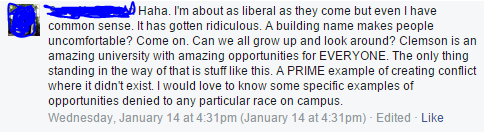


And then there's just plain racism:

Not explicitly racism, but honestly if Mr. Tillman were alive today I don't think most of the students protesting would have the opportunity to attend this school.


There was also a weird thing on twitter Friday (1/16/2015) where a YikYak accused black students of only getting in because of their race and users both refuting that and sharing it. Not even going to touch that, just giving it a huge side-eye (because this is something I can DEFINITELY relate to). 

To be completely honest, I wasn't aware of the full extent of "Pitchfork" Benjamin Tillman's actions until I read many of the articles that were posted this week. Perhaps this is evidence that we've already swept history under the rug? Renaming might not be the answer, but the conversation we're having about weighing his contributions to the university versus his reprehensible actions (calmly murdering a state legislator in the name of Anglo-Saxon purity) needs to happen. 

As I said earlier, I firmly believe in the idea of the Clemson family. When I was talking to a fellow graduate (who is also a person of color), she responded that yes, it's a family... but if something happens we break into smaller groups and shit hits the fan. I'd like to think my alma mater is better than this. I don't want to give up on my peers, especially if they should know better because they went to Clemson. Black students only make up 6% of Clemson's student body versus 28% of South Carolina's population (both are higher than my hometown's 0.4%). Voices shouldn't be ignored just because it's not as popular an opinion- these are our brothers and sisters in orange, so if you truly see orange instead of race, LISTEN. 

I'll close with some words from President Clements:

1/19/15- minor edits- accidentally said "Clemson" instead of "Tillman" in recap, also duplicate of a screenshot 

Wednesday, April 23, 2014

#ClemsonStrong, you're doing it wrong*

*Post title borrowed from Jessika, a friend from Tiger Band
I thought about posting on a different blog, but this one started as a project at Clemson for a course on evolution & creationism, so it's fitting.

A week ago, the Freedom From Religion Foundation released an open letter to Dabo Swinney and the Clemson football program highlighting what they feel is an inappropriate entanglement with religion (in particular, evangelical Christianity) in athletics. FFRF isn't pursuing litigation, but rather is highlighting the questionable practices of maintaining a team chaplain, scheduling devotionals, and taking the team & coaches to church via privately funded buses. These and other intertwined proselytizing were described in a Chronicle of Higher Education article last fall.

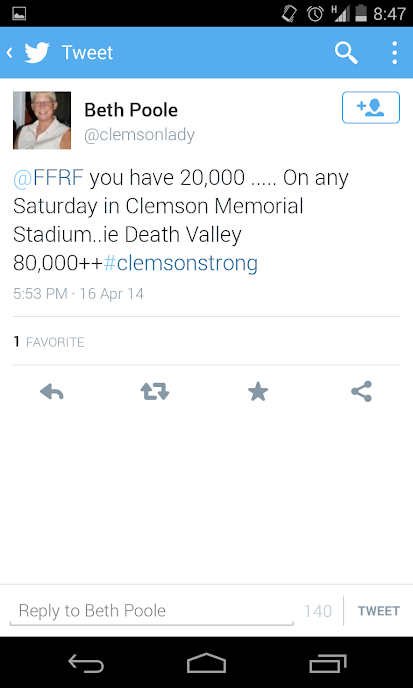
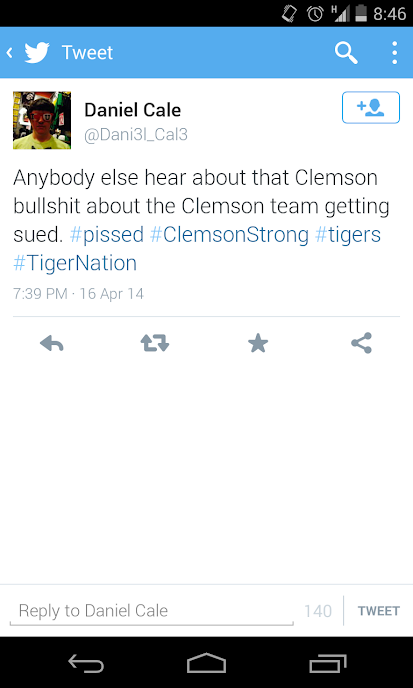
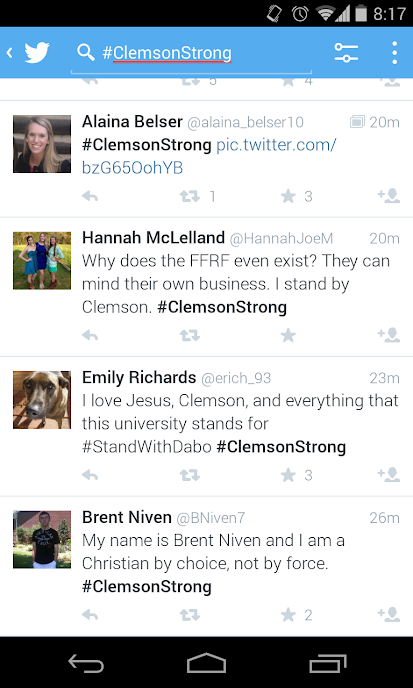
Shortly after this, a firestorm of activity from fans blazed across social media. I noticed this on twitter- in particular the @HillWatch and @ClemsonTom accounts which are incredibly popular, spamming @FFRF with sentiments essentially saying to stay out of our business, we're believers, etc. etc. They in turn egged on fans, especially with the hashtag #ClemsonStrong. A facebook page called "I Support Dabo's Stand for Jesus" popped on facebook and as of this post, has nearly 30,000 members. While I didn't watch facebook too much, I did grab screenshots from twitter, not censoring any names because these are public accounts- I found them with a simple search, and by posting on a public medium they declare their opinions.


In some cases, there seemed to be a misunderstanding (the assumption that Clemson was getting sued). 


Or, a complete misunderstanding of what a public university is- that Clemson is a state school, publicly funded, and if a student desired a specifically religious education, they have numerous options less than 100 miles away. 


Personally, I'm more offended by my fellow Tigers than by Dabo's actions. He released a statement (essentially a nonstatement since he didn't address any of the specific concerns and just performed testimony as my Mormon neighbors back home would say) following Clemson University's own statement where they see no wrongdoing but will investigate claims. In repsonse to part of Dabo's statement where he says the program emphasizes good character & citizenship, FFRF replies that being a good citizen also involves following the Constitution. I think the original letter was a good way to start a dialog, but many have taken it to mean taking a knee jerk reaction and becoming God Warriors.

Dabo's a good ole' boy and isn't likely to change his personal beliefs, and in the South the two most important affiliations are who you root for on Saturday and where you worship on Sunday. However, as many of the posts above demonstrate there is a profound lack of awareness that the overwhelming presence of a majority doesn't nullify the minority. In fact, it's almost disturbing, especially since Clemson added a "Culturious" component to their freshmen orientation. I was the first class to experience it so I'm not sure if it's retained, but it was definitely something they took pride in, even garnering an award for promoting diversity & inclusion in its third year. Why does the FFRF exist, some people ask? Because sometimes communities such as ours need a reminder that the majority does not speak for all. Dr. Roger B. Rollin, emeritus professor of literature at Clemson, recently wrote a Letter to the Editor in the school newspaper, raising alarms that proselytizing may even be going on from professors to students, taking advantage of a powerful position. 

Some of my best memories are at Clemson (if anyone at this point is questioning devotion, I graduated from there and by virtue of Tiger Band for four years attended all home games in my time), and my favorite part is the Clemson family- the idea that all Tigers, no matter your stripe, are bonded by this school. Taking a step back it sounds hokey, but in person my experiences were overwhelmingly positive. When I read posts like the above, I honestly question the welcomeness I felt. Is the Clemson family only a veneer, that only certain members can be considered 'family'? I'd like to think not. #ClemsonStrong shouldn't be about pounding chests for the faith or starting another Crusade, but rather embracing our diversity as what MAKES Clemson a strong institution. 

Wednesday, April 16, 2014

PBS wants you to THINK Wednesday, especially about your inner ancestors!

I confess, I don't watch PBS on a regular basis anymore (or TV in general really because I don't have cable- instead I opt to follow specific shows). However, it was probably the channel I watched the most as a kid- while I have nostalgia for Hey Arnold! and Rugrats like others of my generation, I have even stronger memories of The Magic School Bus, Wishbone, and of course, Bill Nye the Science Guy.

Perhaps on the tailwind of COSMOS, PBS recently started a lineup called "Think Wednesday", a three-hour primetime block from 8-11 PM of science, nature, and technology AWESOME. The first two hours are filled by PBS standbys NATURE and NOVA, and the third is reserved for special programs. Currently, that third slot is filled with Neil Shubin's "Your Inner Fish", a three-part miniseries based on his book of the same name. The first episode (which you can view here) aired last week and continues tonight with "Your Inner Reptile".


Neil is a fish paleontologist based at the University of Chicago and teaches Anatomy & Physiology to a bevy of med students. Some may wonder what someone who does their fieldwork with a shovel instead of a scalpel knows about the way our bodies function, but it actually makes sense- as precursors to tetrapods, you see many similarities between their morphology and ours. While Haeckel's "Ontology recapitulates phylogeny" is a historical footnote in modern biology, side-by-side comparisons of tetrapods at early embryological states are remarkably alike. At a more molecular level, shared expression gradients like Sonic hedgehog indicate relatedness of animals.
No, not that one. Source: Wikia


The graphics are slick, and not as jarring as many other "3D Ancient Life POW!" specials have been. I especially enjoyed seeing prehistoric animals crawl around Neil's locations, half-translucent so their bone structure could be visible.

Neil is a great guide, too- not just another talking head. We follow along with the Tiktaalik discovery, we visit friends (and learn things in the process).

Incidentally, I found out my ear pits are actually a developmental error showing a remnant of my first gill arch.

I am the 1%! Though your odds may be higher if you live elsewhere.


I hope PBS continues this structure beyond the life of "Your Inner Fish"- it's nice to have engaging science content distributed throughout the week (and especially when it doesn't have to fight with other shows in the same timeslot like COSMOS does with The Walking Dead and now Game of Thrones). Props to PBS! Hopefully this is the start of a new age in edutainment.

Thursday, March 20, 2014

Grad school is (surprisingly, but not unexpectedly) busier than anticipated... so my attempted relaunch ended up being another post in a line promising a schedule. Not to sound like a broken record, but I'm going to try and get in the habit. Not going to promise weekly posts, but I'll set the bar low and aim for monthly.

via the NPR article from 2009


I have been writing reviews of books on goodreads as I go along, though, and just finished Don't Be Such A Scientist: Talking Substance in an Age of Style by Randy Olson, and it seems relevant to post it here since I covered his first documentary four years ago. Post is copied below:

This has been on my to-read list for ages, and now that it's semi-relevant to grad school goals, finally took it off my amazon wishlist. I watched Flock of Dodos during Darwin Week 2010; my review of that is here. Curiously, my opinions of his other work reflect what I got four years later in his book.

Dr. Olson argues that since we live in a world of short-attention spans, scientists need to learn to let go of some of the jargon and embrace subjective emotional/sexual/whatever appeal. Arouse the audience, pique their interest, and they'll follow you to your message. It's important for science communication, and here, nearly five years later there's a proliferation of science communication workshops, courses, etc. (I wonder if Randy ever goes to ScienceOnline in Raleigh?)

While his ideas are good, I'm not going to give it a full 4-5 stars because a good portion seemed to be writing out his disappointment in the blogger community on rejecting Sizzle (which I have yet to see). Science blogs are what drew me towards the world of SciComm, and while there are those who are considerably abrasive (PZ Myers, for example), there are many excellent writers out there (Carl Zimmer, Brian Switek, the Deep Sea News team, etc.) who talk about cool things in the science world without getting condescending (I would definitely have a beer with any of them).

Still, readers should take away from this that it's not just what you say, but how you say it that matters. One of Randy's points from Flock of Dodos is that the Intelligent Design movement is full of buzzwords and as I put it at the time, "shiny wrappers" that make it seem like a palatable product. When Bill Nye debated the legitimacy of Intelligent Design with Ken Ham last month, a sizable number in the science community felt it would be validating a worthless idea by even showing up. However, it was watched by millions, and brought Bill's joy in the scientific method to households that would otherwise never be exposed to critical thinking. Sure, Bill's an engineer and didn't have all the technical details right, but he's insanely relatable and easily communicates these big ideas. The reboot of Cosmos by Neil deGrasse Tyson also shares this enthusiasm over science without talking down to the audience. Get rid of the Ivory Tower, and share what you love!

Monday, September 23, 2013

I swear I'll get in the habit this time... also, bobtail squid!

I haven't had a 'real' update in forever, especially since my last several posts were actually articles written for Tigra Scientifica or Decipher. But, since the idea of having a lab blog came up in grad school interviews, I REALLY need to get back in the groove. For a while I had a good pattern for the personal blog, but the science one never launched... time to fix that.

In the last two years, I've graduated from Clemson, moved back west, spent a year at home and am now about to pursue a graduate degree at Oregon State University with zoology (unspecified for now because while I was accepted as a masters student, I am leaning strongly towards switching to the PhD program. A huge helping of impostor syndrome is keeping me from making that decision until after the first quarter, however).

It's funny, because I considered Oregon State when looking for undergrad schools partly because of the Zoology department. High school me wasn't able to articulate that zoology isn't about zoos, though, so when I applied I did so as a pre-bioengineering, hah. That would've been a very different path for sure.

But enough housekeeping! Let's dig into some science.

International Cephalopod Awareness Days are coming up in a couple weeks, and while the tumblr doesn't look like it's been updated since last year, I've been looking forward to this more than Shark Week. While bobtail squid would probably be more of a 10-10 post, they're in a completely different order than typical squid (Sepiolida vs. Teuthida)


Besides being adorable, they're also symbionts with bioluminescent bacteria.


There's actually several labs out there working with Euprymna scolopes and Vibrio fisheri interactions- one in microbiology at UGA has done some sequencing and a University of Wisconsin-Madison lab has interesting ideas about the bacteria as an influence on the squid's circadian clock, which has wonderfully interesting applications for microbiome research.

Actually, symbiosis in general is pretty cool. :-)


Wednesday, November 28, 2012

Interview with David Thornton, Biodiesel Guru

This is an edited version of a slightly longer interview which I may post later- edited because of size constraints for the Spring 2012 issue of Tigra Scientifica for BioSc 494: Popular Science Journalism.
The Clemson Clean Energy project is pretty neat- check them out here!
 
Danielle- The green energy and the biodiesel and the zymology projects are all interconnected. How many related projects are there?
Thornton- Well, we’re going to have to make a lot more Creative Inquiry sections next year because in Green Energy and Biofuels there’s four different groups. One group- all they care to do is make biodiesel. They just want to master bioprocessing and make biodiesel on the pilot plant, and that’s how the pilot plant program got started. Another group looks at how to produce more oils, and one way was to take cafeteria food waste and process it using black soldier flies that will also produce a protein meal, meanwhile turning the organic food waste into compost that they’ll use at the organic farm. We actually just finished, or we’re in the process of constructing that digester right now.
D- You’ve already done some of the feeding of cafeteria waste to the black soldier flies?
T- We’re building our prototype right now, so we’re doing something that’s a tenth of the scale of the final one, and hopefully we’ll start feeding it next week.
It’s a 12 day loading time, and for every square foot of surface area it can process three pounds a day of food waste. It’s not that much, about two fistfuls. Once it goes through a pulper, and it has a lot of water…  but it’s per square foot, so for each tile on this floor you dump that much food in there and the flies will eat it. They self harvest and they self propagate.
D- Okay. So when you mean self-harvest…?
T- They try to climb up to pupate, and what we do is they train them when they have to pupate so they go through these little channels, and they just jump into our bucket!
D-Well, that’s convenient. What other projects are there?
T- Well, we have one trying to make jet fuel out of sunflower oil, which we have some locally produced sunflower seeds. We pressed them in the press we have over at McAdams, and then we refine that oil and convert it into biodiesel. So basically, we’re trying to make this sample of biodiesel and probably only 25% of it will be these polyunsaturated acids which will be very favorable cold flow. We’ll at least be able to take that fraction and send it off for some testing to see if it’s a good source of blended jet fuel. The remaining 75% will melt down and be good transportation fuel. But it is kind of energy-intensive because we’re using freezing cold temperatures to separate it. Just a start to see how our sunflower will perform.
D- And that started this semester, so it’s kind of a new project?
T- Yep, we have one student who-  I think he’s from mechanical engineering- he’s also a pilot and he’s very interested in how to make jet fuel. The Department of Defense and the military are very interested in jet fuel as well, so it’s a possible source of funding if we get good preliminary results from regional sunflowers. This could be a good way to stimulate that production. And there’s another group…
T- We have another creative inquiry called Coproducts, and they make soap, degreaser, and they kind of overlap feeding yeasts and feeding glycerol to algae. So that’s where the overlap really occurs. I’ve actually got four classes going on right now without me there- they made some degreaser and they’re cleaning our biodiesel processing trailer.
D-Sort of doubles as doing work and cleaning up the lab?
T-Yeah! So they’re taking pictures and documenting, they cleaned it with just warm water, they cleaned it with conventional degreaser, and then they cleaned it with their degreaser, taking pictures of each different form, and comparing their pH and their effectiveness, and how much it costs per volume of cleaning. That’s just kind of a fun one that’s not a really scientific but very practical and applicable. If we could convert all of our glycerol on campus to some of the degreaser to clean the floors in the labs, and the rest of it feed it to algae, it’d be an elimination of our waste stream right now to generate value from the coproduct. Part of biosystems engineering is eliminating the term ‘waste product’. Waste is but a resource misused. That’s why we do all this research on finding uses to support the economics basically of renewable fuel production because they’re not so favorable right now.
D- Yeah. And it sounds like you’re sort of working to self-contain systems, like you mentioned with the ethanol and the algae used to go back into the biodiesel and then take the glycerol waste product from that and use it in these other products and it just cycles.
T-Yeah. And that just ties into what our creative inquiries are going to turn into-we’re trying to do a more integrated research approach on, to create on campus an integrated biorefinery.  It means you’d be producing ethanol and biodiesel, and taking those waste products and then powering the plant with gasification using the waste products- or coproducts from those other things. You’d be producing each of the three mainstream biofuels, which are ethanol, biodiesel, and methane that can come in many forms, either anaerobic digestion, methane gas, or in this case, synthesis gas produced from gasification, which are predominantly methane. They could replace propane or natural gas. Self-contained is the goal. That’s the point of this system.
D- Have you gotten a lot of feedback from campus outside of the biodiesels group, like from Aramark?
T- Yeah, we work closely with Facilities… And Aramark, actually- they were the first company to agree to this because it’s their oil and they’re essentially letting us have it to make biodiesel. We can make probably about 3,000 gallons of biodiesel a year. Last year I think we made somewhere around 2,000 gallons. Some of that oil’s disappeared- I think people were thieving it from the receptacles, so now we have locks on our dumpsters. We’re getting a lot more oil, so we know something was wrong last year. This year we should be getting at least 3,000 gallons from just the oil from Aramark. We’re also picking up from Brioso, the new Sweetgrass restaurant, Crocs… but facilities is supporting us to grow. They want us to get to 10,000 gallons a year, which will be half of the diesel fuel consumed on campus. We’ve been running 20% biodiesel, and this week we’re going to bump that up to 25% biodiesel, and gradually get up to see if we can get some vehicles running on 50% biodiesel during the summer months. We have a few vehicles in our department that we run on 100% biodiesel. The feedback from facilities is positive; we just need a way to make more fuel. Hence, we have this research, right?

The New Fisheye View: The Sea in HD

This appeared in the Spring 2012 edition of Tigra Scientifica for BioSc 494: Popular Science Journalism.


The world as we see it is full of a bewildering number of hues, enhancing life with a spectacular array of shades. What if there’s another layer of information and detail we can’t sense, though? Humans only see a small portion of the electromagnetic spectrum. Unlike us, some animals see polarized light, which enhances their world even more, analogous to adding color to a black and white image. In a study at the University of Bristol published in Current Biology February 2012, Dr. Shelby Temple, Professor Justin Temple, and collaborators have discovered that cuttlefish have the most acute polarized vision of any animal observed so far.
            What makes polarized light different? Polarized light rays vibrate in one plane as opposed to multiple planes like other light rays. For humans, polarized light usually means reducing glare with sunglasses or watching a movie in 3D, some organisms have greater purposes for it. In other animals, polarized light is used for navigation and orientation. In 2006, Savannah sparrows were found to use polarized light to determine where north and south is more accurately. The researchers believe that animals may use polarized light in predator/prey detection and in signaling and communication, especially in cephalopods like octopus, squid, and cuttlefish. The cuttlefish species studied here cannot see what humans consider to be visible color wavelengths, so polarized may substitute as a method of seeing the details of its world.
            So, how do you give a cuttlefish an eye exam? To examine the sensitivity of cuttlefish vision, the researchers took LCD computer monitors and removed the polarizing filter. A video was played for the cuttlefish in which an expanding circle mimicked the appearance of a looming predator.  These circles were shown at different levels of grayscale and different angles of light so they were only visible to creatures with polarized sensitivity. When they detected the movement, cuttlefish responded by changing skin patterns. Cuttlefish responded to differences as small as one degree of polarization, significantly more precise than previous species like octopus and crayfish examined which responded to differences of 10 to 20 degrees. 
The researchers also analyzed low- and high-resolution sight by examining images of aquatic life. Because we can’t see differences in polarization, false colors were substituted, and the team found that while animals disappeared into the background in the low-resolution images, they were visible in the high-resolution analysis. This leads Professor Temple to note that camouflage in the polarization dimension has not been investigated and could be the reason why cuttlefish and other predators may have developed high sensitivity to polarized light. The mesmerizingly detailed patterns cuttlefish flash on their skin may also use polarization for detailed signaling and communication, but more research is needed. This study is a great beginning to investigation of alternative ways to sense the world and could be applicable for finding out how animals and plants signal each other- imagine if there were giant ‘DO NOT EAT ME; I’M POISONOUS’ signs we’re not even aware of in everyday life. Perhaps eventually humans too can tap into this other level of vision for navigation and communication purposes. 
 
http://www.sciencedirect.com/science/article/pii/S0960982212000115