Monday, September 3, 2018

Some thoughts on the Crazy Rich Asians film adaptation

Originally posted August 20th to my personal facebook; posting here because 1) a friend asked why I didn't blog and 2) as backup/to find later because searching FB posts is tedious. Bonus because medium change: ability to embed links!

tl;dr- I get wordy on historical precedent and personal experience before finally reviewing Crazy Rich Asians at the end if you wanna scroll to that part.
I feel a tad obligated to write a longer post than my quick thoughts in the comments on previous posts, so bear with me. Partly because it's not a typical thing for various friends to ask "So, what'd you think about [movie]??" but on the other hand, it is more meaningful/relevant to my feelings than say, How to Lose a Guy in 10 Days was, so here's a big ol' thought post I can point at.
When I read "Crazy Rich Asians" a few years ago, I loved in both a 'wow so this is what a beach read is' way and 'yo this is Asian pride and prejudice' kind of thing. Fun, pulls no punches in skewering the people in this ridiculous 1% world, and would have stunning visuals if it ever got picked up for adaptation.
Note that "if". Asian American literature exists, from historical thinly veiled memoirs to serious fiction to fluffy YA lit, but adaptations are few and far between. The last one everyone remembers is The Joy Luck Club in 1993, but like... there are so many other stories that could be made in a visual medium. (not based on books but worth noting: Better Luck Tomorrow in 2001, and the Harold & Kumar trilogy in 2004, 2008, and 2011).
In online discussions if you express disappointment with a whitewashed casting announcement or something, inevitably some chucklefuck will pop in and will either say "Have you considered watching KDramas/overseas cinema?" at best and "Well, I don't demand Japanese movies put a white guy in for my feelings" at worst. The reason these are dissatisfying is that a) it implies that I need to look for an international rather than domestic piece to find reflections of my very domestic-have-not-left-the-US-ever life, b) that despite being a 4th generation US citizen, someone will inevitably assume that I should identify more with foreign content, and c) that American experiences = white experiences so if I am American, I should just accept the predominantly white media here and see myself in Kate Hudson et al's shoes.
It's the same sentiments that in the 1930s sent LA-born Anna May Wong overseas to work on European films after MGM decided to cast a white woman in yellowface for the lead role in The Good Earth (they had already picked a white actor to play the husband, and the Hays code prohibited interracial relationships despite him being in yellow face. More insultingly, the white woman won the Oscar for Best Actress with that role).
Even in person, I recall well-intentioned friends and acquaintances making this "default American = white" assumption. I remember in eighth grade when a friend made a joke in the band room about sneakers being made by kids in China and when I made some noise of displeasure he was like "But why should you be offended; you're American!" In a more serious conversation when discussing what to do with the unplanned pregnancy in 2011, I mentioned adoption rates for nonwhite babies and was told "Oh, we don't even think of you as a person of color; that's not a concern!" :|
These assumptions miss that there are differences between the experiences of Asians and Asian Americans (and this isn't even going into how wildly different experiences are between various Asian American communities- a pan-AsAm identity is a relatively recent idea from the late 1970s). The conflicts between CRA's main character Rachel Chu and her boyfriends' friends/family isn't just socieoeconomic class, but also background- The Shang/Young/T'sien clan left China for Singapore in the 1800s and are old money, whereas Rachel's mom is one of the post-1965 mainlander immigrants to the US. Rachel speaks Mandarin, whereas the Youngs dip into both Mandarin and Cantonese with a smattering of Hokkien (and singlish in the novel). And even though I can identify a lot with Rachel as an ABC (American Born Chinese), my family came to America during the Exclusion era from the Taishan region of Guangdong.
Some of the intercommunity criticism of CRA is that it focuses solely on east Asians (specifically, of Chinese descent) who, relative to other Asian groups, have more privilege- I've seen people suggest that we not be considered people of color- but I'd counter that this is a story about a specific family, and it's sort of akin to asking why Pride and Prejudice doesn't include any Welsh characters. More to the point- P&P doesn't encapsulate British literary identity, as people can look to Dickens or Thackery or the Brontes for other stories with British people (of a period, I guess- a better analogy would also list various other European authors of the era but I can't name any off the top of my head). My personal experience of being the only ABC family in my high school is gonna be different from someone who grew up in the San Gabriel Valley where it's majority Asian American, and that's going to be different than a teen currently living in Dearborn, Michigan, and yet all of these are Asian American viewpoints.
We need *more* stories and cannot rely on one to carry the experiences of the 18 million members of Asian America.
History aside, CRA is a solid romantic comedy, and a good adaptation of a book. The story is streamlined while keeping in the characters relevant to the sequel books (though I do feel it was a miss to omit Nick's very chill dad and Colin & Nick's Turkish friend Mehmet). The movie actually remembers that Rachel is an econ professor specializing in game theory and uses this in a film-only sequence that strengthens the story. Eleanor is nastier in the book, but Michelle Yeoh didn't want her character reduced to a Tiger Mom villainness, and I honestly think it's a best-supporting-actress nom worthy performance. The cast is extraordinary and Astrid continues to be Best Girl (I'd argue she's secretly the trilogy's main character). The movie ends on a high note for most of our characters, but leaves the door open for the threads in the second book, China Rich Girlfriend (and hopefully with an opening weekend like this, Warner Bros will greenlight it).
The movie doesn't break new ground as a romcom (we get a makeover montage, an airport chase, a sassy best friend), but if anything that's partly why it's such a win- people besides Matthew McConaughey and Katherine Heigel can lead romances and make bank at the box office.
p.s. if you want another romantic comedy with hijinks and the chinese vs. chinese american conflict as a plot point, and also features a wedding check out Flower Drum Song, a 1961 Rogers & Hammerstein movie musical
p.p.s diaspora Asian actors didn't pop out of nowhere; there are a fair amount of indie films out there with mostly-AsAm leads like Spa Night and Saving Face, and I *know* I'm missing more because I need to branch out.
p.p.p.s oh gosh this is already too long and i hit post but i just remembered I didn't gush about the food cinematography MY GOD; it's a shame the good dumpling place in town is closed until the school year begins because I have a nee
p.p.p.p.s another mention because I couldn't remember where to fit it in: if anyone's wondering if I teared up, mayyyyyybe some misting up during the wedding sequence, but otherwise my big emotional thing was feeling that nervous stomach butterfly feeling when you're in line for a roller coaster before the opening credits rolled (thanks for the eloquent description of anxiety, Bo Burnham & Eighth Grade) and just like, the wave of relief with the splashy opening.

Tuesday, May 2, 2017

Review: I Contain Multitudes: The Microbes Within Us and a Grander View of Life

I Contain Multitudes: The Microbes Within Us and a Grander View of Life I Contain Multitudes: The Microbes Within Us and a Grander View of Life by Ed Yong
My rating: 5 of 5 stars

In case you were unaware, we are never alone.

The fact we are our own ecosystems can be distressing to some, especially after we've been taught that cleanliness is next to godliness. However, a rich realization lies in recognizing we're also our own islands, that we form microbe archipelagos with the people we live with, and that released introductions from islands with nearby fauna may be the key to healing those with collapsed microbial ecosystems.

Ed Yong delved into this topic three years ago on the TED stage, though in that talk he focused more on microbial manipulation via Wolbachia and Toxoplasma to affect the behavior and biology of hosts. Bacterial control of multicellular organisms can be terrifying... or extremely fascinating, and I'm the latter. There are so many interesting research questions that have yet to be explored regarding the relationship between different microbes, the microbes and host, what the behavior influence is caused by, etc. The multitude of mysteries is almost enough to make me want to go back into academia after leaving it... *almost*. Luckily, if I ever did, the microbiome still seems to be the sexy science topic du jour and we still don't know much about it.

Besides covering a fascinating topic, Ed's writing is sharp, clear, and enjoyable to read. He's long been one of my favorite science writers at his Not Exactly Rocket Science blog (moving between an independent site, the early-but-influential ScienceBlogs network, Discover, and National Geographic over the past decade before ending earlier this year), and still writes great long-form pieces over at The Atlantic. After some mid-2000s grumbling about whether or not blogs were a threat to journalism, it is extremely gratifying to see in the 2010s, the definition between who is a blogger and who is a journalist have blurred and that yes, some can even make the jump to the longest form writing of all- books.

A sidenote: I recently finished my masters in a lab that is heavily focused on symbiosis and evolution at different levels (my PI's previous work involves competing mitochondrial genomes; others in the lab work on anemone-algae relationships and the interaction between Wolbachia and plant-parasitic nematode), so I did come to this book with some prior knowledge. It's a little weird when reading and then coming across the name of a biologist I follow on twitter (John McCutcheon! Katie Hinde!) or a friend's PI (Rebecca Vega-Thurber!) The world may seem big, but Twitter makes it smaller and as you read, check to see if the referenced scientist is online- @ ing them is a great way to show an interest in their work because often, it feels like the only other people reading are those in the research community.

View all my reviews

Monday, April 17, 2017

Review: Eight Flavors: The Untold Story of American Cuisine

Eight Flavors: The Untold Story of American Cuisine Eight Flavors: The Untold Story of American Cuisine by Sarah Lohman
My rating: 5 of 5 stars

The easiest and often most enjoyable way to get to know a culture is through its food, and the makeup of American flavor covers not just the taste spectrum of spicy, sweet, and umami but also the history of immigration waves and economics.

Sarah Lohman of the Four Pounds Flour blog noticed in old cookbooks there were certain flavor profiles popping up, such as rose water as a baked goods sweetener rather than vanilla because vanilla was prohibitively expensive. She made a timeline of recipes through history and plotted them with Google Ngrams to see word frequency use between 1796 and 2000. These eight flavors were the noticeable peaks (chocolate and coffee were also popular, but they're extensively covered elsewhere), and are organized chronologically by when they appeared in American kitchens.

I was unsurprised to find that some flavors, such as black pepper and vanilla, became common after entrepreneurs and botanists figured out ways to make them more widely available and to actually cultivate respectively. Others, like chili and curry powders, come from the desire for a premixed pack, easy to reach without putting in the effort of roasting and mixing spices anew for each use.

Soy sauce and garlic were both interesting to me because they became widely available due to immigrant groups (Chinese and Italians) but were deemed too "ethnic" until a more "respectable" culture's food became #goals (Japanese and French cuisine). This bias is still around- think about how much people are willing to spend at an upscale sushi place, then try to remember how much you paid at your last dim sum visit.

My absolute favorite parts (which I also noted on Twitter) were when Lohman pointed out that compounds are compounds- regardless of source, vanillin will have the same structure and its atoms won't remember if they were derived from a vanilla vine or processed from leftover lignin from wood. Monosodium glutamate is its own flavor profile and yes, if you intake too much salt you will feel terrible, but the amounts of MSG in food are not the horrifically high concentrations used in early misleading studies of "Chinese Restaurant Syndrome". As someone with a genetics background who lives in the PNW, I am wary whenever some group touts their "natural" foods, as if natural can be quantified and measured somehow when really it's just emotion.

If a heftier read is desired, there's a very comprehensive notes for all sources and a selected bibliography for specific works in the back.

View all my reviews

Wednesday, April 5, 2017

Review: The Genius of Birds

The Genius of Birds The Genius of Birds by Jennifer Ackerman
My rating: 5 of 5 stars

Fully deserving of all of its accolades last year, The Genius of Birds finds that sweet spot of an interesting, compelling popular science book without being a bone-dry textbook.

(I always like to see what other reviewers think as I write my own, and I'm a lil' amused to see some people disliked this because it was *too* fluffy whereas others didn't care for Ackerman's extensive literature references. Popular science comes with a broad audience, I suppose.)

The Genius of Birds is divided up by different types of intelligence- as much as we'd like to think smarts is the only thing that counts, intelligence can be considered in different categories- social intelligence (do I know who my relatives are, and do I care? How do I react to my kin, or the hottie next door?), aesthetics (bowerbirds and sexy son hypothesis), spatial (various ways birds might map their world), etc. Ackerman examines current (as of writing/publication) literature and research, interviewing scientists working in the field, and weaves in the natural history of the focus species. Corvids of course appear frequently, but other birds make appearances with sparrows having the final chapter as a species that has co-evolved with our artificial habitats.

Would recommend for people who like popular science books, those with a passing interest in neuroscience of non-hominids, and people who like birds.

View all my reviews

Thursday, March 9, 2017

Review: The Dragon Behind the Glass: A True Story of Power, Obsession, and the World’s Most Coveted Fish

The Dragon Behind the Glass: A True Story of Power, Obsession, and the World’s Most Coveted Fish The Dragon Behind the Glass: A True Story of Power, Obsession, and the World’s Most Coveted Fish by Emily Voigt
My rating: 5 of 5 stars

Emily Voigt writes in that part-historical examination, part-author's exploration narrative that The Immortal Life of Henrietta Lacks also treads, and the result ended up being a very readable, fascinating book. Multiple threads (the exotic pet trade industry, regulation of endangered species, what is a species and who names them, etc.) are woven together deftly as she starts with an initial question ("Why would someone pay hundreds of thousands of dollars for a homely-faced fish?") and ends up diving headfirst into obsessively pursuing the dragonfish, searching for any that may still be in the wild.

I'm a hobby aquarist who has nothing larger than a 29 gallon at the moment, but the monster fishkeepers always intrigue me. Heiko Bleher is the most prominent ichthyologist in the book with an intrepid personality, though Tyson Roberts looms equally large as does Ralf Britz.

Minor quibbles: I'm a little surprised that she hadn't really known much about Linnaeus until she pursued the arowana story (especially if she's a science writer for Radiolab and other places). If you want a deeper dive into the taxonomy of what the Asian arowana is vs. the South American species or how exactly do purchasers of these monster fish take care of them, look elsewhere. Otherwise, it's a well-crafted personal narrative blended with natural history and taxonomy with a dash of travelogue.

View all my reviews

Friday, March 3, 2017

Review: Goldilocks and the Water Bears: The Search for Life in the Universe

Goldilocks and the Water Bears: The Search for Life in the Universe Goldilocks and the Water Bears: The Search for Life in the Universe by Louisa Preston
My rating: 2 of 5 stars

"It was ok" is maybe the most positive I feel towards this book. I'm not exactly sure what audience Dr. Preston is aiming for, but I definitely felt like the prose was intended for a teenager or younger. Science communication often tackles with how to inform your audience without necessarily being condescending; Goldilocks and the Water Bears introduces lots of concepts and helpfully italicizes them when first mentioned, giving off the feel of a textbook. Some of these chapters, like the one describing what defines life and conditions life might need, definitely felt textbook-ish, especially with several italicized vocabulary words per paragraph.

One of my earlier criticisms as I was reading was that I'm finding pop culture references walk a fine line between potentially dated and cool enough to draw the reader in. The first chapter of this book discusses science fiction and how our space fantasies may inspire us to develop similar technologies or look for life in various ways. While not the focus of the book, the short explanations for some pieces of media (like The Hitchhiker's Guide to the Galaxy) were very general- I initially dismissed this as "Well, it is a tangent so best not to linger on it..."

I read a library copy, and an earlier reader had penciled in corrections in a few places (slashing through a comma at one point, correcting numbers elsewhere, and in a later chapter, crossing out "carnivorous" and writing in "allotrophic" in the margins).

I also take issue with the use roughly once a chapter of "Fun fact: [fact here]." If it's a fun fact, shouldn't the fact speak for itself?

Perhaps her TED talk is more engaging, but the prose is very eh. I'd maybe recommend this to a middle or high school reader.

View all my reviews

Thursday, February 23, 2017

Review: Nonsense: The Power of Not Knowing

Nonsense: The Power of Not Knowing Nonsense: The Power of Not Knowing by Jamie Holmes
My rating: 4 of 5 stars

In a "post-fact" society, does it matter whether we know something or not? Although Nonsense was published before even primary season took place, this was an unintentionally timely read. I personally tend to prefer knowing versus the unknown, so learning the uses of and embracing (or at least feeling comfortable with) not knowing seems relevant, too.

In general, Nonsense is a very readable book, perfect for the popular science reader but well-cited with extensive end notes (on a stylistic note, I liked that they weren't numbered in the text because that can be distracting, and reading linearly made them a bit of a reminder of what earlier chapters covered. While some were simple citations, others were longer descriptions of context around quotations or events).

In the first part, Mr. Holmes prompts us to notice how we respond to ambiguity, and how the need for closure catches our attention, makes us assume, and potentially distresses us when the situation is particularly unexpected. The middle section highlights examples of reactions to unexpected or ambiguous situations from natural disasters and hostage crises to the unpredictable world of fashion trends and whether or not more medical tests will really clear up an unclear diagnosis (spoiler alert: it may be more costly for the patient, but for that see The Empowered Patient: How to Get the Right Diagnosis, Buy the Cheapest Drugs, Beat Your Insurance Company, and Get the Best Medical Care Every Time). The final part covers how embracing the unknown is useful: where failure is often the stepping stone to scientific progress and taking away constraints of preconceived notions on your perspective may lead to new insights.

I've seen the phrased tossed around re: graduate school "The more you learn, you realize how little you actually know." This is a lesson I need to be reminded of, and Nonsense reminded me that it's okay if I don't know the answers.

Obtained via Blogging for Books in exchange for an unbiased review- took me longer to get around this than intended, but better late than never.

View all my reviews

Monday, December 5, 2016

Review: The Dim Sum Field Guide: A Taxonomy of Dumplings, Buns, Meats, Sweets, and Other Specialties of the Chinese Teahouse

The Dim Sum Field Guide: A Taxonomy of Dumplings, Buns, Meats, Sweets, and Other Specialties of the Chinese Teahouse The Dim Sum Field Guide: A Taxonomy of Dumplings, Buns, Meats, Sweets, and Other Specialties of the Chinese Teahouse by Carolyn Phillips
My rating: 4 of 5 stars

I received a copy from Blogging for Books in exchange for a review, although this had been on my to-read list way earlier after reading the Lucky Peach Beginner's Guide to Dim Sum. While this blog was intended to be primarily science (with more than the occasional tangent into politics), this book still fits as science communication by taking the language of field guides and applying them to food (which some people consider edible chemistry)!

If you're not familiar with the Cantonese cuisine of dim sum, this is a neatly organized introduction. Dishes are organized by cooking method (steamed savory, baked savory, extras, desserts, etc.) and both Mandarin and Cantonese pronunciations are given. Illustrations and cross-sections are helpful, but as with field guides, some users may find pictures more handy (though that's nothing a Google search couldn't solve). Where this guide shines is in the thorough, sensual descriptions of food from the sheen of a glaze or the crackling of a lightly pan fried wrapper under your teeth.


I've read various 'field guides' over the years, both actual for-the-field and books in the style (consider The Field Guide to Lake Monsters, Sea Serpents, and Other Mystery Denizens of the Deep by Loren Coleman and Patrick Huyghe, though they might actually intend it to be used to identify cryptids). The parts of The Dim Sum Field Guide that tickled my biological fancy were identifying each type as a genus with variations listed as species (and if there weren't any, Sui generis or a class of their own). "Nesting Habits" describes how the dish is usually plated, though dumplings may be "nestled together", etc. I can see how this was intended for use in the food field, but as with a birding trip, do your homework. Rather than taking this guide to dim sum with you, I suggest reading beforehand and making a list of what you're interested in trying if it makes you feel comfortable. In my experience, though, you can often just point at what looks good on carts passing by!

View all my reviews

Thursday, November 10, 2016

Living in a Safety Blanket?: Or, the Physical Echo Chamber

Between looking at last night's election map and reading this NYT piece, I've been thinking about cliquishness, diasporas, and fear (among other things, anyway).

I've lived in three and a half places throughout my life: most of the time in cities smaller than 100k (with the exception of my ~2 months in Boise, which is the half). For the majority of my life, it's been in red state country, though my time in South Carolina was definitely in a university bubble.

When I think about if I'd ever return to my hometown, or if I ask high school friends if they'd ever go back, the first response is usually a solid NOPE. Part of it may be lack of opportunity (in my case, scientific jobs are mostly re: nuclear energy or agricultural, and there aren't major publishing houses where creative friends could work), part of it could be there are more attractive wages elsewhere (minimum wage is $7.25/hour, though cost of living is also cheaper). The Idaho Statesman did an article on this millennial flight, and I agree with people in my peer group:

“It’s frustrating that the Legislature always questions why people leave, but then they ruin things we care about: higher education, women’s rights, a living wage, affordable health care, LGBT rights, the environment,” Moroney said. “That’s a hostile environment to come in as a young person if you want to see change.”
 Anecdotally, several people in my HS friend group ended up in the PNW. I absolutely love living in Oregon. Based on local measures, I can tell the community here cares about education, LGBT rights, and stewarding our environment. But I'm in western Oregon. Earlier this year, the Malheur Wildlife Refuge was occupied by people protesting federal ownership of lands. Granted, the leaders of the occupation were mostly from out of state, but this happened here, not the South or wherever we imagine conservative bogeymen to be. (Anecdotally, Idaho's seen an increase in doomsday prepper types, so there's that).

I defended my masters last month, and am trying to figure out where to apply for jobs- realistically, anywhere. I've jokingly said to my significant other, "Oh, what if that dream job ends up being in Alabama?" and he responds with "Nope, wouldn't be worth it." He grew up on the gulf coast and worked outside of the university bubble in South Carolina and knows how awful people can be.

But I wonder: is there any hope for deep-rooted attitudes to disappear if the people who have casual thoughts never encounter someone different from them? For instance, to many evangelicals, a woman who has an abortion has committed murder. And maybe, she's a slut who should've kept her legs shut. Statistically, they (and you and I) know someone who's had one, and the women who do usually have children already. But there's no one visible to dispel the notion of Slutty McSlutface, why shouldn't they continue to believe it? This is partly why I'm vocal about mine in social media- to put a face on the Other.

A thread on r/asianamerican a few weeks ago was from a Californian who noted that all his friends lived in diverse city enclaves (Seattle, DC, SoCal). However, Cali cost of living is high and much of flyover country is cheap. Moving would be something to consider, except they didn't want to raise their young child in a place where they'd be a minority, where they'd be the only Asian, etc. They feared their child would be subject to racism.

Honestly? I can't say their fear is entirely wrong- after all, the murder of Vincent Chin happened in Michigan. But, if Joe Schmo from Somewheresville, IA never grows up with people who are different from him, what's to prevent media shorthand- stereotypes- from filling in how he sees them? He might not realize how badly some things affect people different from him if he doesn't have a face to it. As I recall from an argument a decade ago with an uncle: "Why should I care if gay people can get married or not? It doesn't affect me..." Increased empathy and countering bias are benefits from a diverse classroom.  Avoiding the midwest won't help it magically become more diverse.

At the same time, though, my feelings of fear for my safety in a Trump presidency aren't gone- and it's not necessarily fear of what Trump will do, but rather the people who voted for him that are okay with violence. I've seen a few cases on my feed of conservative friends saying "Stop calling me a racist, misogynistic bigot, because I'm not!" and sure, I'm not afraid of them wanting to jail me. However, I feel like they enabled the smaller but more vocal number of people who slash tires, who intimidate brown people, who are okay with punching people they disagree with in the face. I understand the need to live where I don't feel threatened.

But at the same time, I see the need to educate people, to be a blue girl in a red state. To be an advocate for those who the majority harm.

There isn't an easy answer, and I don't see myself sleeping well tonight either.

Sunday, November 6, 2016

Review: Voyage of the Basilisk

Voyage of the Basilisk Voyage of the Basilisk by Marie Brennan
My rating: 5 of 5 stars

This was delightful. I haven't read Voyage of the Beagle by Charles Darwin yet, so I'm not sure if I missed references (and I imagine actual Victorian travelogues are more verbally dense, but then again it might be analogous to her in-world book, Around the World in Search of Dragons).

I'm a fan of natural history, so combining natural history and fantasy means I adore this series. And in the third installment of the memoirs of Lady Trent, we go seaborne: first towards the arctic in search of sea serpents, then to not!South America where we meet our new archaeologist friend who happens to own a diving bell, and then through a bit of sailing and political strife end up in not!Hawaii. All the while, Isabella struggles over how dragon taxonomy should work: do the classical bins fit, or are there more subtle gradients, especially given sea serpents and fire lizards have some features but not all? I cannot recall other fiction books that consider their zoology like this and if anyone knows of any, please mention them in the comments!

As in The Tropic of Serpents, analogues to real world cultures are done well, with shades of historical attitudes but without making our heroine either a historically accurate but not fun jerk or out-of-place with modern sensibilities. Gender and roles in not!Hawaii in particular are handled gracefully- (view spoiler)

View all my reviews

Monday, October 31, 2016

Review: The Power of Habit: Why We Do What We Do in Life and Business

The Power of Habit: Why We Do What We Do in Life and Business The Power of Habit: Why We Do What We Do in Life and Business by Charles Duhigg
My rating: 4 of 5 stars

I first came across this work when an excerpt of the Target customer habit tracking was posted online somewhere in 2012, and it was relevant, interesting, yet terrifying.

A repost of Duhigg breaking his afternoon cookie habit came across my twitter feed earlier this year.

When I saw this at the library a month ago, it seemed like a sign that I should finally get around to reading this, and like reading anything on TVTropes, once you see patterns, you can't unsee them.

The thesis of The Power of Habit lies in our habit circle: a cue happens, we're compelled to perform our habit, and then get rewarded. Sometimes only a hint of a cue is required for us to automatically apply the habit, expecting reward. Duhigg demonstrates this again and again through anecdotes on an individual level, a company's level, and at a national level (the power of weak ties in the civil rights movement of the 1960s, for example).

The notes section is quite extensive should you wish to continue reading on a particular topic, and it's also fascinating to see what various entities had to say (or didn't say) when asked for fact-checking comments.

I can only hope that awareness of the cycle can be harnessed to change some of my own fidgety actions.

View all my reviews

Tuesday, August 9, 2016

Review: House of Lost Worlds: Dinosaurs, Dynasties, and the Story of Life on Earth

House of Lost Worlds: Dinosaurs, Dynasties, and the Story of Life on Earth House of Lost Worlds: Dinosaurs, Dynasties, and the Story of Life on Earth by Richard Conniff
My rating: 5 of 5 stars

Like The Rarest of the Rare: Stories Behind the Treasures at the Harvard Museum of Natural History and Stuffed Animals and Pickled Heads: The Culture and Evolution of Natural History Museums, this examines the natural history of a natural history museum. Unlike RotR, House goes beyond collections and recalls the history of the Peabody Museum itself, from how it initially began as collections in search of home, eventually given by George Peabody, uncle to O.C. Marsh of the Bone Wars. Marsh takes up over half the chapters of this book, as he should given his large personality.

I enjoyed how Conniff takes the story of the museum all the way into modern day, with the age of DNA and discoveries still being made from collection store rooms (deciphering fossilized ink, for example, came from one of Marsh's long forgotten invertebrate fossils). There are plenty of sidebars throughout chapters of other interesting stories of Peabody Museum curators and researchers who could easily have had their own chapters.

View all my reviews

Thursday, July 28, 2016

Review: The Society of Genes

The Society of Genes The Society of Genes by Itai Yanai
My rating: 3 of 5 stars

In the intro, the authors say that while The Selfish Gene was important, it didn't answer the question of how said selfish genes interacted, and this, a more "holistic perspective" builds on that. In ten chapters, Yanai and Lercher cover topics from the last couple decades of research, starting with the mutations required for cancer, green beard genes, how different is the .5% difference between individual humans (still millions of base pairs), positive feedback loops, and endosymbiosis theory, among other things.

Aimed at a general audience with illustrated metaphors, this is a great introduction to current genetic knowledge (or a refresher if it's been a while since undergrad genetics). I still haven't read The Selfish Gene, so I can't judge how well this works as a successor in describing ideas on how genes interact and function (I assume TSG is also aimed at a general audience, but I also think it might be deeper? Won't know until I've read it).

View all my reviews

Wednesday, July 20, 2016

Review: The New Wild: Why Invasive Species Will Be Nature's Salvation

The New Wild: Why Invasive Species Will Be Nature's Salvation The New Wild: Why Invasive Species Will Be Nature's Salvation by Fred Pearce
My rating: 4 of 5 stars

I seem to have unintentionally gotten into a "how should humanity address current ecological concerns" kick this year, as The New Wild continues on themes previously touched on in Resurrection Science: Conservation, De-extinction and the Precarious Future of Wild Things and The Sixth Extinction: An Unnatural History. The New Wild doesn't tread the exact same paths as the other books, as Sixth Extinction depicted a rather morose view of the anthropocene and Resurrection Science examined ways we try to mitigate what we've caused. Instead, The New Wild considers the ecosystems we have now: a mix of native and non-native species in a constantly changing environment.

Fred Pearce is rather pointed about challenging the orthodoxy of typical conservation- he posits there are no 'pristine' ecosystems and what we often think of as pristine have still been shaped by humanity for thousands of years, so why try to preserve a fixed point in time when nature is constantly changing? Various examples of invasives filling in niches of native plants that were wiped out because of people are placed in context as providing habitat/food/etc. for endangered species native to the area, or how something that can be endangered in one place is considered invasive in another. Pearce bolsters his argument by pointing out how shaky some of the statistics and numbers used to vilify invasives are.

It's a persuasive argument. I'm not convinced it should be taken whole cloth (as it could easily slide to "Oh, well, nature will recover so let's go ahead and build this new farm or whatever"), but nuances are certainly needed for conservation efforts.

View all my reviews

Wednesday, July 6, 2016

Review: Under a Wild Sky: John James Audubon and the Making of the Birds of America

Under a Wild Sky: John James Audubon and the Making of the Birds of America Under a Wild Sky: John James Audubon and the Making of the Birds of America by William Souder
My rating: 4 of 5 stars

A pleasure to read. Previously I was dimly aware of Audubon's background beyond the acclaimed naturalist who painted life-size birds (if you ever get to see the original size of the folios, they are *massive). Who knew that he was a bastard son of a sea captain (inb4 "Hey should this be shoved at Lin-Manuel Miranda?") and self-trained naturalist could go toe-to-toe with European zoologists and then some, yet at the same time build up his persona as a roguish American frontiersmen with embellishments and some outright zoological fabrications (the description of rattlesnakes as tree-dwellers, for example)?

I would have liked to see some of the prints referenced (especially those in the chapters' epigraphs), but there are plenty of other books for that.

View all my reviews

Tuesday, June 28, 2016

Goodreads review: Resurrection Science: Conservation, De-extinction and the Precarious Future of Wild Things by M.R. O'Connor

Resurrection Science: Conservation, De-extinction and the Precarious Future of Wild ThingsResurrection Science: Conservation, De-extinction and the Precarious Future of Wild Things by M.R. O'Connor
My rating: 4 of 5 stars

Resurrection Science: Conservation, De-extinction and the Precarious Future of Wild Things feels like a companion/response to The Sixth Extinction: An Unnatural History because the touch on similar themes: what have we humans done to our ecosystems? Unlike Sixth Extinction, though, Resurrection Science examines some of the efforts in response to what seems to be one of the biggest massive die-offs we've seen.

Or is it? The intro muses over how we define the numbers of species going extinct and how we calculate it. It seems as the rates have been overestimated so that's somewhat cheering, but habitats are still being lost at a rapid rate. When we make efforts to conserve a species, just what are we conserving- the species itself, as many amphibian species such as the spray toads of Kihansi in Tanzania have their largest populations in captivity, or habitat restoration? What about the Frozen Arks-we preserve the DNA, the blueprints for many organisms, but does that save behaviors and interactions between species? (If we continue the blueprint analogy, it's like using Anasazi blueprints for a kiva but not really knowing what to use it for or how the ceremonies were performed)

Technology can be used for good (Ben Novak's passenger pigeon project is nothing short of ambitious, but also amazing considering he was able to extract over 60% passenger pigeon DNA from museum specimens- a huge win for studying old DNA). But, it shouldn't be considered a substitute for a more comprehensive view of our world, and while we can rescue species, does it matter if their habitats and their interactions are gone?

As my last couple updates indicate, I really enjoyed the coda where O'Connor considers why we feel this drive to save endangered/revive extinct species- what exactly is "nature" and "natural" in an age where Homo sapiens have touched every part of the globe in the last thousands of years? Pupfish populations are isolated and scattered- if one originated because a fish biologist moved them to a non-military site location, is it natural, or does that even matter because pupfish are so rare? The intangibility of 'nature' doesn't mean we shouldn't try to atone for our actions as a species, but consideration should be made on why we feel the need to do so.


View all my reviews

Saturday, June 18, 2016

Goodreads review: Lab Girl by Hope Jahren.

Goodreads now has an option to port reviews over to blogs, so because I need to get back in the habit of blogging, you might see some of the science ones here!

Lab GirlLab Girl by Hope Jahren
My rating: 5 of 5 stars

I'd heard some buzz about this, and saw it on the 14 day limit shelf at my local library but didn't get around to it until the day before it was due. I wish I had started earlier though, because much of Hope Jahren's writing is clear, moving, and ever so quotable. Part memoir, part paleobiology facts (from a biochemical perspective), part reflections on what it is to be a female scientist in today's world, this book is easily my favorite so far this year.

Jahren is also unapologetic when describing having mental health issues while trying to be a functional scientist, let alone person, which is something I can really identify with currently. Less identifiable is finishing a PhD in four years then going straight from that to a professor position at age 26...! But I think that speaks more to how academia's landscape has changed in the last twenty years rather than any kind of science precociousness.


View all my reviews

Friday, March 20, 2015

I am the MS of my Fate, I am the Captain of my Goals?

I'm a second year masters student, and I find there's a bee in my bonnet.

The BS is the new high school diploma, so for any kind of specialized work (especially science), a graduate degree is a must. However, PhD programs take such a huge investment of time and energy that they should only be entered if one has a clear idea of what they want to get out of it, whether it be a job in academia or leader of an industry project.

So, get a masters degree, right? They're one of the more rapidly growing degree programs, largely thanks to MBA and M. Ed degrees (and companies that sponsor the cost of higher education for employees). It also creates another pivot point to switch disciplines if you find that you don't entirely fit one, but would maybe feel more comfortable somewhere else. Many biological science doctoral programs require a masters beforehand, and credits can transfer should you choose to go on in academia.

The problem I find, however, or at least cannot shake from my personal headcanon is that it sort of feels like a consolation prize. This is a monumentally stupid perception considering the percentage of Americans with a graduate degree is ~11.77% compared to ~31% of Americans who have a bachelors or higher. . I know people with masters; I know people who have gotten MS degrees in the last several years. Within my department, though, there's about a handful of students who intentionally entered as a masters, and another few who got an MS after they had to scale back their initial PhD proposals. In other departments/disciplines, failure to pass qualifying exams means getting the consolation masters to indicate that grad work had been done, but not enough to be a candidate.

I'm a scientist (or at least, I'm nominally one- that debate is open to interpretation because I certianly don't attempt science daily), so let's consider those data points mentioned above.
Or maybe I am, if twitter documentation counts. 


It's again, incredibly dimwitted to view an MS as a consolation prize when one in five Americans don't go on to college after high school, and the graduate school matriculation rate is roughly around 460,000 people a year. If we narrow the lens on biology PhD programs (~16,000 a year), 70% go on to do a postdocs and of those, only 15% of postdocs will go on to a tenure-track academic job (ASCB 2014).


So why do I feel so down about it? A colleague mentioned Thesis Whisperer's Valley of Shit, and I've seen numerous other posts about grad student struggles and impostor syndrome. It weirds me out though, that these all often come from the perspective of PhD candidates- on the masters timeline, there's the added stress of trying to get done in two, or as is more often the case three years. I also have the personal problems of lack of focus and tying my success rate to my emotional well being, which are both again, hugely problematic areas. There needs to be a culture change- slowly, people are recognizing that tenure-track isn't a tenable position for every grad student. Perhaps the next step is recognizing that it's okay to not make the giant academic leap in one degree.

Sunday, January 18, 2015

Revisiting the Clemson Family: #SaveTillman's Darker Side

One day, I'll actually post about science again (hopefully this term because I'm taking a seminar on getting more involved with science communication!) Instead, it's another round of "I love you, but I'm disappointed in you" to the Clemson community.

From last time:
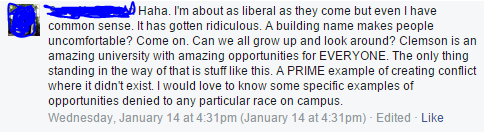
Some of my best memories are at Clemson (if anyone at this point is questioning devotion, I graduated from there and by virtue of Tiger Band for four years attended all home games in my time), and my favorite part is the Clemson family- the idea that all Tigers, no matter your stripe, are bonded by this school. Taking a step back it sounds hokey, but in person my experiences were overwhelmingly positive. When I read posts like the above, I honestly question the welcomeness I felt. Is the Clemson family only a veneer, that only certain members can be considered 'family'? I'd like to think not. #ClemsonStrong shouldn't be about pounding chests for the faith or starting another Crusade, but rather embracing our diversity as what MAKES Clemson a strong institution. 
Weird, that the words still mostly apply about nine months later. Again, we see a majority feel persecuted, but this time it's a different minority, and one that cannot be closer to the Clemson family... because it IS a part of the Clemson family.

If you haven't paid much attention to what's going on around TigerTown, there's been a string of negative incidents over the last few months.

  • Following Darren Wilson's lack of conviction and the lack of indictment in Eric Garner's death (recap for both incidents here), protests against racial profiling and police brutality took place in cities and on campuses across the country, including Clemson. A small but passionate group of students led several protests, including  a "die-in" on Bowman Field. On the app YikYak where users anonymously post and others can up or downvote them, there was a small but vocal counter response: 
  • Shortly after the uproar over anonymous insensitivity, history repeated itself and a greek organization hosted a 'Cripmas' party. When the story first broke, quite a few commenters mentioned they didn't see it as offensive, putting it on the same level as mafia or wild west themed parties. While well-intentioned, such sentiments missed the point that having a 'gangsta' themed party soon after the Michael Brown decision (in which some media outlets and peanut galleries called the teenager a 'thug) was poorly timed, not to mention the trivialization of gang brutality. 
  • In response, See the Stripes organized a student protest on Library Bridge. President Clements was present and addressed student questions. He later sent out an email encouraging the Clemson family to come together and announcing several initiatives towards discussing diversity in 2015. 
  • 2015 is here! Members of Clemson's faculty, staff, and student body marched from Death Valley to Sikes, airing a list of grievances of when the university "failure to fulfill and uphold Mr. Clemson's vision and its own mission, particularly to "educate undergraduate and graduate students to think deeply about and engage in the social, scientific, economic and professional challenges of our time" among other things. 
  • Clemson's Faculty Senate votes to rename Tillman Hall, but tables the motion. The facutly senate can't actually change the name, but can make a recommendation to the Board of Trustees, which can then bring it up in the state legislature. 

Now we're caught up. And Tiger Nation? I love you, but man do we need empathy everywhere. 

While there are those that agree with the proposal, I've seen mostly a backlash (and maybe that's my feeds, but it feels large... like a majority maybe...). It falls into a few categories, illustrated here by various facebook, twitter, and change.org comments, mostly that the name is traditional/iconic for Clemson. Curiously, despite Tillman being a seminal figure in the creation of Clemson University, the building we now know today as Tillman was the "Old Main Building" until 1940 when Tillman's son pushed to rename it (ironically because he felt his father's legacy was being forgotten). 

I'm not going to weigh in on whether it should or should not be changed. If I had the answer, I'd probably be forwarding it to the faculty senate and board of trustees, but there's no easy solution here. Tillman's actions are reprehensible- this goes beyond the racist attitudes of the day, but outright murdering people and bragging about it. He also was instrumental in Clemson's founding. They don't cancel each other out, but there's no simple metric for measuring impact against each other. 

Instead, I'm going to focus on how some of the backlash, though well-intentioned, is antithetical to the idea of the Clemson Family. 

Mostly, the ones that say "If you don't like it, don't go here." I don't know if it's a vocal minority, but I keep seeing it. 


It also seems a little weird to me to accuse a minority of bullying the majority- "You made me uncomfortable with your uncomfortableness", essentially. 


Thjs one is pretty disappointing. I know HillWatch aligned with #ClemsonStrong last spring, but the account was entertaining enough. Outright telling students to leave? Nope, unfollowed. 


Unlike the #ClemsonStrong reaction, it's not an outsider group asking for change. It's students, staff, and faculty AT Clemson! To me, this is an incredibly rude thing to say, especially if these students, faculty, alumni, etc. have been involved with Clemson just as long as (if not more than) some of the people telling them to go. This is what saddens me even more. 


There's also seems to be this idea that the students who feel uncomfortable are just making trouble out of nothing: 


And then there's just plain racism:

Not explicitly racism, but honestly if Mr. Tillman were alive today I don't think most of the students protesting would have the opportunity to attend this school.


There was also a weird thing on twitter Friday (1/16/2015) where a YikYak accused black students of only getting in because of their race and users both refuting that and sharing it. Not even going to touch that, just giving it a huge side-eye (because this is something I can DEFINITELY relate to). 

To be completely honest, I wasn't aware of the full extent of "Pitchfork" Benjamin Tillman's actions until I read many of the articles that were posted this week. Perhaps this is evidence that we've already swept history under the rug? Renaming might not be the answer, but the conversation we're having about weighing his contributions to the university versus his reprehensible actions (calmly murdering a state legislator in the name of Anglo-Saxon purity) needs to happen. 

As I said earlier, I firmly believe in the idea of the Clemson family. When I was talking to a fellow graduate (who is also a person of color), she responded that yes, it's a family... but if something happens we break into smaller groups and shit hits the fan. I'd like to think my alma mater is better than this. I don't want to give up on my peers, especially if they should know better because they went to Clemson. Black students only make up 6% of Clemson's student body versus 28% of South Carolina's population (both are higher than my hometown's 0.4%). Voices shouldn't be ignored just because it's not as popular an opinion- these are our brothers and sisters in orange, so if you truly see orange instead of race, LISTEN. 

I'll close with some words from President Clements:

1/19/15- minor edits- accidentally said "Clemson" instead of "Tillman" in recap, also duplicate of a screenshot 

Wednesday, April 23, 2014

#ClemsonStrong, you're doing it wrong*

*Post title borrowed from Jessika, a friend from Tiger Band
I thought about posting on a different blog, but this one started as a project at Clemson for a course on evolution & creationism, so it's fitting.

A week ago, the Freedom From Religion Foundation released an open letter to Dabo Swinney and the Clemson football program highlighting what they feel is an inappropriate entanglement with religion (in particular, evangelical Christianity) in athletics. FFRF isn't pursuing litigation, but rather is highlighting the questionable practices of maintaining a team chaplain, scheduling devotionals, and taking the team & coaches to church via privately funded buses. These and other intertwined proselytizing were described in a Chronicle of Higher Education article last fall.

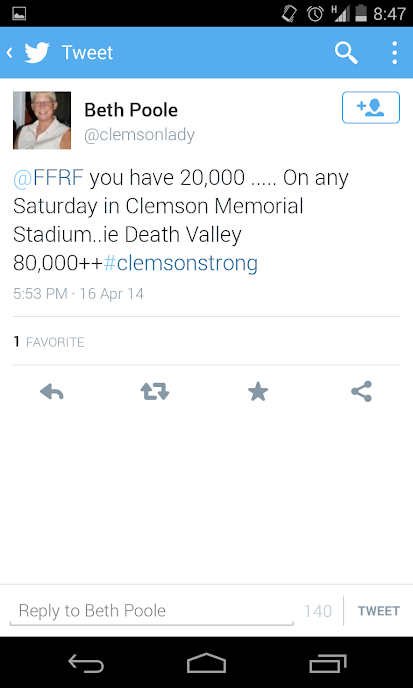
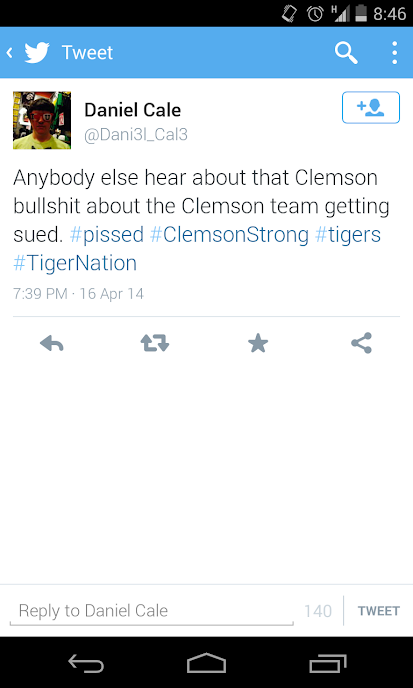
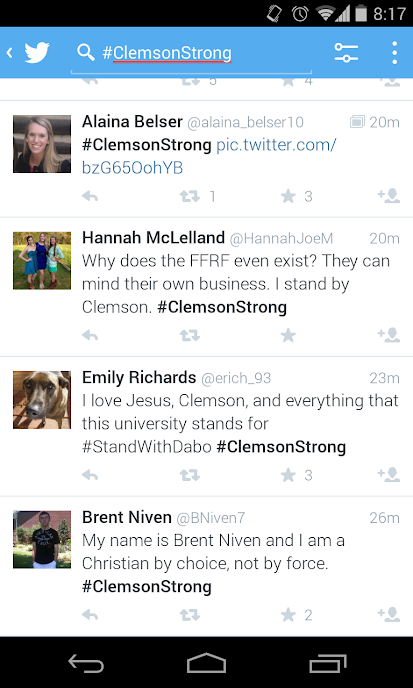
Shortly after this, a firestorm of activity from fans blazed across social media. I noticed this on twitter- in particular the @HillWatch and @ClemsonTom accounts which are incredibly popular, spamming @FFRF with sentiments essentially saying to stay out of our business, we're believers, etc. etc. They in turn egged on fans, especially with the hashtag #ClemsonStrong. A facebook page called "I Support Dabo's Stand for Jesus" popped on facebook and as of this post, has nearly 30,000 members. While I didn't watch facebook too much, I did grab screenshots from twitter, not censoring any names because these are public accounts- I found them with a simple search, and by posting on a public medium they declare their opinions.


In some cases, there seemed to be a misunderstanding (the assumption that Clemson was getting sued). 


Or, a complete misunderstanding of what a public university is- that Clemson is a state school, publicly funded, and if a student desired a specifically religious education, they have numerous options less than 100 miles away. 


Personally, I'm more offended by my fellow Tigers than by Dabo's actions. He released a statement (essentially a nonstatement since he didn't address any of the specific concerns and just performed testimony as my Mormon neighbors back home would say) following Clemson University's own statement where they see no wrongdoing but will investigate claims. In repsonse to part of Dabo's statement where he says the program emphasizes good character & citizenship, FFRF replies that being a good citizen also involves following the Constitution. I think the original letter was a good way to start a dialog, but many have taken it to mean taking a knee jerk reaction and becoming God Warriors.

Dabo's a good ole' boy and isn't likely to change his personal beliefs, and in the South the two most important affiliations are who you root for on Saturday and where you worship on Sunday. However, as many of the posts above demonstrate there is a profound lack of awareness that the overwhelming presence of a majority doesn't nullify the minority. In fact, it's almost disturbing, especially since Clemson added a "Culturious" component to their freshmen orientation. I was the first class to experience it so I'm not sure if it's retained, but it was definitely something they took pride in, even garnering an award for promoting diversity & inclusion in its third year. Why does the FFRF exist, some people ask? Because sometimes communities such as ours need a reminder that the majority does not speak for all. Dr. Roger B. Rollin, emeritus professor of literature at Clemson, recently wrote a Letter to the Editor in the school newspaper, raising alarms that proselytizing may even be going on from professors to students, taking advantage of a powerful position. 

Some of my best memories are at Clemson (if anyone at this point is questioning devotion, I graduated from there and by virtue of Tiger Band for four years attended all home games in my time), and my favorite part is the Clemson family- the idea that all Tigers, no matter your stripe, are bonded by this school. Taking a step back it sounds hokey, but in person my experiences were overwhelmingly positive. When I read posts like the above, I honestly question the welcomeness I felt. Is the Clemson family only a veneer, that only certain members can be considered 'family'? I'd like to think not. #ClemsonStrong shouldn't be about pounding chests for the faith or starting another Crusade, but rather embracing our diversity as what MAKES Clemson a strong institution.