Thursday, July 28, 2016

Review: The Society of Genes

The Society of Genes The Society of Genes by Itai Yanai
My rating: 3 of 5 stars

In the intro, the authors say that while The Selfish Gene was important, it didn't answer the question of how said selfish genes interacted, and this, a more "holistic perspective" builds on that. In ten chapters, Yanai and Lercher cover topics from the last couple decades of research, starting with the mutations required for cancer, green beard genes, how different is the .5% difference between individual humans (still millions of base pairs), positive feedback loops, and endosymbiosis theory, among other things.

Aimed at a general audience with illustrated metaphors, this is a great introduction to current genetic knowledge (or a refresher if it's been a while since undergrad genetics). I still haven't read The Selfish Gene, so I can't judge how well this works as a successor in describing ideas on how genes interact and function (I assume TSG is also aimed at a general audience, but I also think it might be deeper? Won't know until I've read it).

View all my reviews

Wednesday, July 20, 2016

Review: The New Wild: Why Invasive Species Will Be Nature's Salvation

The New Wild: Why Invasive Species Will Be Nature's Salvation The New Wild: Why Invasive Species Will Be Nature's Salvation by Fred Pearce
My rating: 4 of 5 stars

I seem to have unintentionally gotten into a "how should humanity address current ecological concerns" kick this year, as The New Wild continues on themes previously touched on in Resurrection Science: Conservation, De-extinction and the Precarious Future of Wild Things and The Sixth Extinction: An Unnatural History. The New Wild doesn't tread the exact same paths as the other books, as Sixth Extinction depicted a rather morose view of the anthropocene and Resurrection Science examined ways we try to mitigate what we've caused. Instead, The New Wild considers the ecosystems we have now: a mix of native and non-native species in a constantly changing environment.

Fred Pearce is rather pointed about challenging the orthodoxy of typical conservation- he posits there are no 'pristine' ecosystems and what we often think of as pristine have still been shaped by humanity for thousands of years, so why try to preserve a fixed point in time when nature is constantly changing? Various examples of invasives filling in niches of native plants that were wiped out because of people are placed in context as providing habitat/food/etc. for endangered species native to the area, or how something that can be endangered in one place is considered invasive in another. Pearce bolsters his argument by pointing out how shaky some of the statistics and numbers used to vilify invasives are.

It's a persuasive argument. I'm not convinced it should be taken whole cloth (as it could easily slide to "Oh, well, nature will recover so let's go ahead and build this new farm or whatever"), but nuances are certainly needed for conservation efforts.

View all my reviews

Wednesday, July 6, 2016

Review: Under a Wild Sky: John James Audubon and the Making of the Birds of America

Under a Wild Sky: John James Audubon and the Making of the Birds of America Under a Wild Sky: John James Audubon and the Making of the Birds of America by William Souder
My rating: 4 of 5 stars

A pleasure to read. Previously I was dimly aware of Audubon's background beyond the acclaimed naturalist who painted life-size birds (if you ever get to see the original size of the folios, they are *massive). Who knew that he was a bastard son of a sea captain (inb4 "Hey should this be shoved at Lin-Manuel Miranda?") and self-trained naturalist could go toe-to-toe with European zoologists and then some, yet at the same time build up his persona as a roguish American frontiersmen with embellishments and some outright zoological fabrications (the description of rattlesnakes as tree-dwellers, for example)?

I would have liked to see some of the prints referenced (especially those in the chapters' epigraphs), but there are plenty of other books for that.

View all my reviews

Tuesday, June 28, 2016

Goodreads review: Resurrection Science: Conservation, De-extinction and the Precarious Future of Wild Things by M.R. O'Connor

Resurrection Science: Conservation, De-extinction and the Precarious Future of Wild ThingsResurrection Science: Conservation, De-extinction and the Precarious Future of Wild Things by M.R. O'Connor
My rating: 4 of 5 stars

Resurrection Science: Conservation, De-extinction and the Precarious Future of Wild Things feels like a companion/response to The Sixth Extinction: An Unnatural History because the touch on similar themes: what have we humans done to our ecosystems? Unlike Sixth Extinction, though, Resurrection Science examines some of the efforts in response to what seems to be one of the biggest massive die-offs we've seen.

Or is it? The intro muses over how we define the numbers of species going extinct and how we calculate it. It seems as the rates have been overestimated so that's somewhat cheering, but habitats are still being lost at a rapid rate. When we make efforts to conserve a species, just what are we conserving- the species itself, as many amphibian species such as the spray toads of Kihansi in Tanzania have their largest populations in captivity, or habitat restoration? What about the Frozen Arks-we preserve the DNA, the blueprints for many organisms, but does that save behaviors and interactions between species? (If we continue the blueprint analogy, it's like using Anasazi blueprints for a kiva but not really knowing what to use it for or how the ceremonies were performed)

Technology can be used for good (Ben Novak's passenger pigeon project is nothing short of ambitious, but also amazing considering he was able to extract over 60% passenger pigeon DNA from museum specimens- a huge win for studying old DNA). But, it shouldn't be considered a substitute for a more comprehensive view of our world, and while we can rescue species, does it matter if their habitats and their interactions are gone?

As my last couple updates indicate, I really enjoyed the coda where O'Connor considers why we feel this drive to save endangered/revive extinct species- what exactly is "nature" and "natural" in an age where Homo sapiens have touched every part of the globe in the last thousands of years? Pupfish populations are isolated and scattered- if one originated because a fish biologist moved them to a non-military site location, is it natural, or does that even matter because pupfish are so rare? The intangibility of 'nature' doesn't mean we shouldn't try to atone for our actions as a species, but consideration should be made on why we feel the need to do so.


View all my reviews

Saturday, June 18, 2016

Goodreads review: Lab Girl by Hope Jahren.

Goodreads now has an option to port reviews over to blogs, so because I need to get back in the habit of blogging, you might see some of the science ones here!

Lab GirlLab Girl by Hope Jahren
My rating: 5 of 5 stars

I'd heard some buzz about this, and saw it on the 14 day limit shelf at my local library but didn't get around to it until the day before it was due. I wish I had started earlier though, because much of Hope Jahren's writing is clear, moving, and ever so quotable. Part memoir, part paleobiology facts (from a biochemical perspective), part reflections on what it is to be a female scientist in today's world, this book is easily my favorite so far this year.

Jahren is also unapologetic when describing having mental health issues while trying to be a functional scientist, let alone person, which is something I can really identify with currently. Less identifiable is finishing a PhD in four years then going straight from that to a professor position at age 26...! But I think that speaks more to how academia's landscape has changed in the last twenty years rather than any kind of science precociousness.


View all my reviews

Friday, March 20, 2015

I am the MS of my Fate, I am the Captain of my Goals?

I'm a second year masters student, and I find there's a bee in my bonnet.

The BS is the new high school diploma, so for any kind of specialized work (especially science), a graduate degree is a must. However, PhD programs take such a huge investment of time and energy that they should only be entered if one has a clear idea of what they want to get out of it, whether it be a job in academia or leader of an industry project.

So, get a masters degree, right? They're one of the more rapidly growing degree programs, largely thanks to MBA and M. Ed degrees (and companies that sponsor the cost of higher education for employees). It also creates another pivot point to switch disciplines if you find that you don't entirely fit one, but would maybe feel more comfortable somewhere else. Many biological science doctoral programs require a masters beforehand, and credits can transfer should you choose to go on in academia.

The problem I find, however, or at least cannot shake from my personal headcanon is that it sort of feels like a consolation prize. This is a monumentally stupid perception considering the percentage of Americans with a graduate degree is ~11.77% compared to ~31% of Americans who have a bachelors or higher. . I know people with masters; I know people who have gotten MS degrees in the last several years. Within my department, though, there's about a handful of students who intentionally entered as a masters, and another few who got an MS after they had to scale back their initial PhD proposals. In other departments/disciplines, failure to pass qualifying exams means getting the consolation masters to indicate that grad work had been done, but not enough to be a candidate.

I'm a scientist (or at least, I'm nominally one- that debate is open to interpretation because I certianly don't attempt science daily), so let's consider those data points mentioned above.
Or maybe I am, if twitter documentation counts. 


It's again, incredibly dimwitted to view an MS as a consolation prize when one in five Americans don't go on to college after high school, and the graduate school matriculation rate is roughly around 460,000 people a year. If we narrow the lens on biology PhD programs (~16,000 a year), 70% go on to do a postdocs and of those, only 15% of postdocs will go on to a tenure-track academic job (ASCB 2014).


So why do I feel so down about it? A colleague mentioned Thesis Whisperer's Valley of Shit, and I've seen numerous other posts about grad student struggles and impostor syndrome. It weirds me out though, that these all often come from the perspective of PhD candidates- on the masters timeline, there's the added stress of trying to get done in two, or as is more often the case three years. I also have the personal problems of lack of focus and tying my success rate to my emotional well being, which are both again, hugely problematic areas. There needs to be a culture change- slowly, people are recognizing that tenure-track isn't a tenable position for every grad student. Perhaps the next step is recognizing that it's okay to not make the giant academic leap in one degree.

Sunday, January 18, 2015

Revisiting the Clemson Family: #SaveTillman's Darker Side

One day, I'll actually post about science again (hopefully this term because I'm taking a seminar on getting more involved with science communication!) Instead, it's another round of "I love you, but I'm disappointed in you" to the Clemson community.

From last time:
Some of my best memories are at Clemson (if anyone at this point is questioning devotion, I graduated from there and by virtue of Tiger Band for four years attended all home games in my time), and my favorite part is the Clemson family- the idea that all Tigers, no matter your stripe, are bonded by this school. Taking a step back it sounds hokey, but in person my experiences were overwhelmingly positive. When I read posts like the above, I honestly question the welcomeness I felt. Is the Clemson family only a veneer, that only certain members can be considered 'family'? I'd like to think not. #ClemsonStrong shouldn't be about pounding chests for the faith or starting another Crusade, but rather embracing our diversity as what MAKES Clemson a strong institution. 
Weird, that the words still mostly apply about nine months later. Again, we see a majority feel persecuted, but this time it's a different minority, and one that cannot be closer to the Clemson family... because it IS a part of the Clemson family.

If you haven't paid much attention to what's going on around TigerTown, there's been a string of negative incidents over the last few months.

  • Following Darren Wilson's lack of conviction and the lack of indictment in Eric Garner's death (recap for both incidents here), protests against racial profiling and police brutality took place in cities and on campuses across the country, including Clemson. A small but passionate group of students led several protests, including  a "die-in" on Bowman Field. On the app YikYak where users anonymously post and others can up or downvote them, there was a small but vocal counter response: 
  • Shortly after the uproar over anonymous insensitivity, history repeated itself and a greek organization hosted a 'Cripmas' party. When the story first broke, quite a few commenters mentioned they didn't see it as offensive, putting it on the same level as mafia or wild west themed parties. While well-intentioned, such sentiments missed the point that having a 'gangsta' themed party soon after the Michael Brown decision (in which some media outlets and peanut galleries called the teenager a 'thug) was poorly timed, not to mention the trivialization of gang brutality. 
  • In response, See the Stripes organized a student protest on Library Bridge. President Clements was present and addressed student questions. He later sent out an email encouraging the Clemson family to come together and announcing several initiatives towards discussing diversity in 2015. 
  • 2015 is here! Members of Clemson's faculty, staff, and student body marched from Death Valley to Sikes, airing a list of grievances of when the university "failure to fulfill and uphold Mr. Clemson's vision and its own mission, particularly to "educate undergraduate and graduate students to think deeply about and engage in the social, scientific, economic and professional challenges of our time" among other things. 
  • Clemson's Faculty Senate votes to rename Tillman Hall, but tables the motion. The facutly senate can't actually change the name, but can make a recommendation to the Board of Trustees, which can then bring it up in the state legislature. 

Now we're caught up. And Tiger Nation? I love you, but man do we need empathy everywhere. 

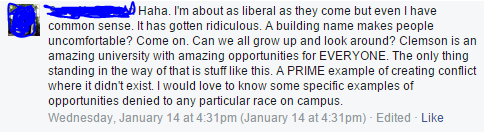
While there are those that agree with the proposal, I've seen mostly a backlash (and maybe that's my feeds, but it feels large... like a majority maybe...). It falls into a few categories, illustrated here by various facebook, twitter, and change.org comments, mostly that the name is traditional/iconic for Clemson. Curiously, despite Tillman being a seminal figure in the creation of Clemson University, the building we now know today as Tillman was the "Old Main Building" until 1940 when Tillman's son pushed to rename it (ironically because he felt his father's legacy was being forgotten). 

I'm not going to weigh in on whether it should or should not be changed. If I had the answer, I'd probably be forwarding it to the faculty senate and board of trustees, but there's no easy solution here. Tillman's actions are reprehensible- this goes beyond the racist attitudes of the day, but outright murdering people and bragging about it. He also was instrumental in Clemson's founding. They don't cancel each other out, but there's no simple metric for measuring impact against each other. 

Instead, I'm going to focus on how some of the backlash, though well-intentioned, is antithetical to the idea of the Clemson Family. 

Mostly, the ones that say "If you don't like it, don't go here." I don't know if it's a vocal minority, but I keep seeing it. 


It also seems a little weird to me to accuse a minority of bullying the majority- "You made me uncomfortable with your uncomfortableness", essentially. 


Thjs one is pretty disappointing. I know HillWatch aligned with #ClemsonStrong last spring, but the account was entertaining enough. Outright telling students to leave? Nope, unfollowed. 


Unlike the #ClemsonStrong reaction, it's not an outsider group asking for change. It's students, staff, and faculty AT Clemson! To me, this is an incredibly rude thing to say, especially if these students, faculty, alumni, etc. have been involved with Clemson just as long as (if not more than) some of the people telling them to go. This is what saddens me even more. 


There's also seems to be this idea that the students who feel uncomfortable are just making trouble out of nothing: 


And then there's just plain racism:

Not explicitly racism, but honestly if Mr. Tillman were alive today I don't think most of the students protesting would have the opportunity to attend this school.


There was also a weird thing on twitter Friday (1/16/2015) where a YikYak accused black students of only getting in because of their race and users both refuting that and sharing it. Not even going to touch that, just giving it a huge side-eye (because this is something I can DEFINITELY relate to). 

To be completely honest, I wasn't aware of the full extent of "Pitchfork" Benjamin Tillman's actions until I read many of the articles that were posted this week. Perhaps this is evidence that we've already swept history under the rug? Renaming might not be the answer, but the conversation we're having about weighing his contributions to the university versus his reprehensible actions (calmly murdering a state legislator in the name of Anglo-Saxon purity) needs to happen. 

As I said earlier, I firmly believe in the idea of the Clemson family. When I was talking to a fellow graduate (who is also a person of color), she responded that yes, it's a family... but if something happens we break into smaller groups and shit hits the fan. I'd like to think my alma mater is better than this. I don't want to give up on my peers, especially if they should know better because they went to Clemson. Black students only make up 6% of Clemson's student body versus 28% of South Carolina's population (both are higher than my hometown's 0.4%). Voices shouldn't be ignored just because it's not as popular an opinion- these are our brothers and sisters in orange, so if you truly see orange instead of race, LISTEN. 

I'll close with some words from President Clements:

1/19/15- minor edits- accidentally said "Clemson" instead of "Tillman" in recap, also duplicate of a screenshot